Indian Flute
The wonderful sound of an indian flute can be heard in most indian songs.
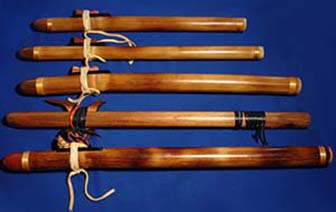
If you have never heard an Indian flute being played, you might be pleasantly surprised. The Indian flute has a wonderful sound and many excellent musicians enjoy playing them. But, the Indian flutes are also often admired for their great craftsmanship and beauty.
Five prehistoric Indian flutes were discovered in Arizona in 1931 that dated as far back as 620 AD. The legend of the Indian flute is that a brave saw a tree limb on the ground that had been split in two. Each end was hollowed by a woodpecker who then pecked several holes in one-half of the limb. When he took the limb to the medicine man, he suggested the young brave out the two pieces together and the Indian flute was born.
Indian flutes are usually made of western red cedar, eastern aromatic cedar, redwood or spruce, although sometimes the flute makers will use hard woods. The key of the flute is determined by both the size of the flute and the hole placement. Those just learning to play the Indian flute often start with a flute that includes the keys of A, G, and F# (F sharp). These are among the most popular flute keys, but G#, F, E and Low C are also used. If you are purchasing your first Indian flute, it is suggested that you start with a flute that has very high or very low pitches. These are flutes that include the keys High C, D, E and Low B and A.
The type of Indian flute you choose also depends on hand size. Those with smaller hands will be able to use an A or G# flute very easily. Those new to the Indian flute that have average or large hands will fine the G or F# flute easier to play. The F flutes generally have more space between the holes, requiring someone with larger hands. Indian flutes usually increase in price as the size and tone change.
Related Stories:
Indian Flute Articles Home PageThe following lists catalog the specific articles, stories, legends and research materials of this website.
American Indian Topics | American Indian Products | American Indian Tribes
Native American Topics | Indigenous Peoples’ Literature
