Indian Chief
The American Indian chief leads his people in peace and war.
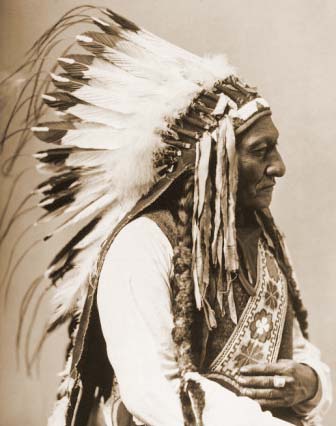
There have been many great Indian chiefs throughout history. To become an Indian chief, you had to prove that you were strong, brave, and a great leader.
You have probably heard of many of the more famous Indian chiefs. Cochise was the Indian chief of the Apache. He was known as a fierce warrior and led a resistance against both the Mexicans and the white man in the 1800s. The Apaches lived in what is now known as northern Mexico, New Mexico and Arizona. Cochise was captured and escaped many times before his final capture. He refused to leave what he felt was his people’s land and eventually lived out his life on an Arizona reservation. Another famous Indian chief who was also an Apache was Geronimo. Like Cochise, he also made many daring escapes when captured, but was never allowed to return to his home land. He was contained at Fort Sill, Oklahoma as a prisoner. Despite that, he became somewhat of a celebrity in his old age. He appeared at the 1904 World’s Fair and other fairs, selling photographs and souvenirs before his death in 1909.
Sitting Bull was a famous Sioux Indian chief. He was the Indian chief that battled General George Custer and the United States 7th Calvary at the Battle of Little Bighorn. The mixture of Sioux and Cheyenne Indians annulated the Army and was perhaps the most famous of all Indian battles.
Like Geronimo, Sitting Bull enjoyed the limelight later in life. He toured with Buffalo Bill Cody’s Wild West Show. It is said that he cursed the audiences in his own language, much to their amusement.
Most Indian chiefs today are very peaceful compared to those of long ago. But despite whether peaceful or fierce, Indian chiefs have earned the respect of their people.
Related Stories:
Indian Chief Articles Home PageThe following lists catalog the specific articles, stories, legends and research materials of this website.
American Indian Topics | American Indian Products | American Indian Tribes
Native American Topics | Indigenous Peoples’ Literature
