Chief Joseph
Chief Joseph was a great leader of the Nez Perce Indians.
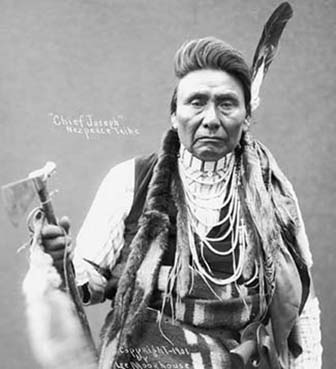
Chief Joseph was a very admirable man who fought for his tribe until his death. In 1877, Chief Joseph was the leader of the Nez Perce Indians during the war against the US. He made many attempts to make peace between the Native American Indians and the white settlers, but it never worked out.
When Chief Joseph was younger he was given a tribal name: Hin-mah-too-yah-lat-kekeht. In English this would mean: “Thunder Rolling in the Mountain.” His given name, however, was Joseph, named after his father. His father was baptized as Joseph by one of the white missionaries that had came down to baptize the Indians in 1838.
The Old Joseph
Before Chief Joseph, The Nez Perce Indians had always gotten along well with the white settlers. In fact, there was good standing between them since their very first encounter with Lewis and Clark in 1805. However, old Joseph and many of the Nez Perce leaders would sign a treaty giving over some of their land to the United States in order to keep their sacred Wallowa Valley untouched.
In 1863, this would all come to an abrupt stop when white settlers discovered gold and tried to make the Indians sign a new treaty giving up their land. Old Joseph was angry, disgusted enough to tear up his bible and go back to the ways of his own people. He refused to sign the new treaty even after several of the Nez Perce leaders did. Before dieing in 1871, he told his son, “This country holds your father’s body. Never sell the bones of your father and your mother.”
Chief Joseph
Old Joseph's son became Chief after his father passed away, and remembering his father’s words would only make Chief Joseph more convinced never to sell. He would stand up against the white settlers, even if it meant war. But he tried hard to keep the peace between his Indian tribe and the white man. Chief Joseph saw that more and more white men were coming, and one time during one of their treks a few of his tribe snuck away, attacked a white settlers camp, and killed 34 men. Chief Joseph knew that even though his men had won the battle, there would always be more white men. They fought many battles before finally getting captured and being forced to live on a reservation. Chief Joseph would never give up on his tribe and he fought to the very end. In 1904 he passed away; some say of a broken heart, while others say old age. He had always believed that if you treated all men the same, there would be peace. Today, his grave stone is marked by three Indians in headdress standing guard.
Related Stories:
Chief Joseph Articles Home PageThe following lists catalog the specific articles, stories, legends and research materials of this website.
American Indian Topics | American Indian Products | American Indian Tribes
Native American Topics | Indigenous Peoples’ Literature
