A Pack of Wolves
Often the similiarities between a Pack of Wolves have been compared to a Tribe of Indians.
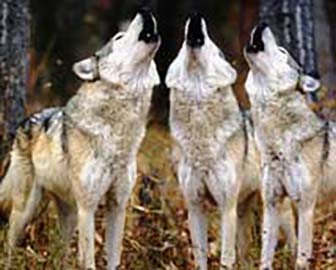
In many ways, a pack of wolves and a tribe of Indians have significant similarities. They both work for the greater good of the pack or tribe, they hunt for all to eat, and are both led by a single leader. It isn’t surprising that because of these similarities, the American Indians had a great respect for wolves and viewed them as a significant part of the world with which they lived harmoniously.
Many Native Americans credit the wolves for teaching them about the importance of family and how to hunt and forage for food. In other words, they were credited with the livelihood of the tribe.
Misconceptions at times arise over the dangers a pack of wolves present. In reality, a healthy, thriving pack of wolves presents no real danger to humans and threaten only livestock. However, a pack of wolves hunts only what it needs to feed the pack and doesn’t hunt just for the kill. In fact, ranchers near Yellow Stone National park during the period following the reintroduction of wolves to the park in 1996 stated that the loss of livestock caused by a particular pack of wolves only accounts for a small portion of their overall loss.
Nonetheless, wolves remain a protected species in the United States and the reintroduction to wilderness areas in the U.S. is difficult. Much like their harmonious friends the Native American Indians, the wolf has been allocated only specific areas in which they can live. The adaptation of a pack of wolves into semi-wilderness is difficult as they often hunt domesticated animals like cats and dogs. This practice is naturally upsetting to people near areas where the reintroduction is attempted.
Though the US population of wolves is significantly less than what it was even a hundred years ago, North America is still home to many wolves, even the Timber Wolf and the Grey Wolf. Canada supports over an estimated 50,000 individual wolves with its vaster wilderness areas. It is presently illegal to hunt a pack of wolves in the United States, but the coyote, a close relation to the wolf, does have an open season. Coyotes are also pack animals, but are known to stray singly more so than wolves. Their population is denser and they have adapted better to human interference.
Coyote Fur and its Uses Today
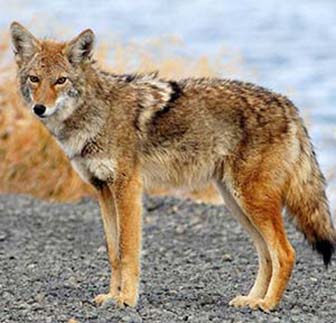
At night, Native American Indians could hear the sound of the coyote howling. With their high pitched howling, it's no wonder that the coyote became the center of many of the Native American Indians legends, stories, and folklore. These wild animals howl to help stay in touch with other coyotes. Coyote means, barking dog, which suits them well, but the actual word coyote is from an Aztec Indian word "coyotl". Hearing a coyote at night is more common than actually seeing one any time during the day or night. Coyotes are nocturnal. They run in small packs but will hunt for food alone.
The coyote is the topic of many Indian songs and stories. He is often the trickster with his cunning ways and often the stories tell of tribal rules and why they should not be broken. Though there are many coyote stories among the Indians, the ending is almost always the same. The coyote always is tricked in the end.
Several crafts and clothing items of the American Indians were made from coyote fur. Bow and arrow quivers were completely wrapped in coyote fur. Today this may be thought of as a crude wrapping but it is also quite costly as a treasured artifact. War bonnets can still be purchased with handing coyote tails making this Navajo design unique and definitely a collector’s item. Coyote fur also hangs below Chickasaw turtle rattles, making this a treasured keepsake.
Though the Native American Indians thought of the coyote as cunning and clever, able to weave his way out of difficult situations, today collectors of coyote statues big and small, claim that the coyote is the protector of the home. Since coyotes lived underground in dens, their homes were protected and so it is believed, you will be also.
Coyote Facts and their Role in Native American Culture.
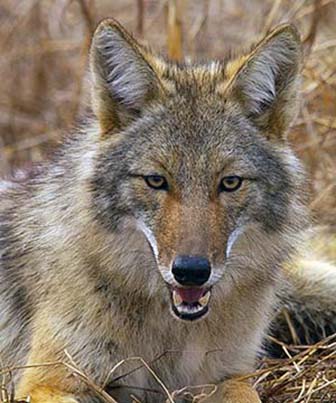
The coyote has been given a bad rap for years, thanks to stories handed down of them mauling humans. And let’s not forget Wile E. Coyote of Looney Tunes fame! The truth of the matter is that humans should foot most of the blame for the coyote’s bad rap. The coyote facts are this: Humans have been encroaching on the territory of the coyote for years. And when we humans destroy the very land in which they live and hunt, we are taking away their livelihoods.
Coyote facts show that they are part of the same family as dogs. They can be found in places like Alaska all the way down into Mexico and Central America. Because of the human element, they have had to constantly adapt to changing conditions in their land. It is important to note in your coyote facts that you should never feed or leave food for coyotes. This behavior will bring them closer than ever to our territory and increases the potential for injuries when coyotes encounter humans.
Because coyotes are secretive and are predatory, they can co-exist close to us humans without us ever knowing they are around. It is this secretiveness that brings about other coyote facts in relation to Native American culture.
The coyote is present in a lot of Native American folklore and is often cast in a variety of roles. Deceiver, realist, goofball and survivor … these are but a few of the roles that these doggie relatives played. Coyote facts state that these animals represented the original Indians in Native American folklore.
With traits characteristic of humans, the coyote stars in a number of these Indian stories and teachings, much like the white man’s fables and stories with a moral to them. These coyote tales are passed down generation to generation and used to illustrate the foibles of the human race.
Endangered and misunderstood, the native American wolf
In times past, the native American wolf was plentiful all across the United States. Today, native American wolfs are endangered. The native American wolf have had their habitat destroyed and have been wantonly hunted.
The native American wolf are social animals, so if you were privileged enough to see one of them you will probably see more. In fact, the native American wolf love to run in packs of from anywhere between two of them, to over a dozen. The native American wolf has even been known to cross breed with coyotes.
It is common for a family of the native American wolf to remain together throughout life.
By displaying superior strength, a male native American wolf can earn the position of pack leader.
The native American wolf has a strong heritage with the common dog, and can make their home in a variety of settings, including mountainous ranges or forests.
Carnivorous, the native American wolf has shown themselves to be a threat to livestock and even humans. The native American wolf can weigh more than a hundred pounds, so it is easy to see how they could be dangerous to humans.
The native American wolf tend to mate for life, and show quite a bit of affection toward each other. Typically, the native American wolf will have just one litter of pups a year.
After birth, the mother wolf cares for the pups the first few weeks, but then the entire pack of the native American wolf becomes involved in the raising and protecting of the litter.
Native American wolf packs communicate with one another through body language and facial expressions. The leader of the native American wolf pack can always be identified by his erect stanza, stiff legged posture, and tail that is curled toward the back.
If a native American wolf is frightened, it tucks its tail between its legs, flattens its ears, and tries to shrink its body size. But if you should ever see a native American wolf bristled fur and crouching body, look out. The native American wolf will most likely attack.
The native American wolf also communicates through its howl. Howling can mean the leader of the native American wolf pack want the others of the pack to meet him at a certain place, it can mean a marking of territory, but can also be used as a call to come and get it after a kill.
The native American wolf has a hefty appetite, and for this reason usually hunts larger animals, although certainly they will eat small rodents and rabbits. Commonly, they prefer moose, elk and deer, but don’t hesitate to go after bison.
Perhaps more than any other animal, the native American wolf permeates myths and legends, anywhere from being a protector, to the fearsome werewolf.
The native American wolf can live to be around sixteen years old.
Great care is presently being put forth to locate, protect and reintroduce the native American wolf to wildlife, where it can once again roam free and increase in population.
The role of Timber Wolves in Native American culture
Native Americans have often held timber wolves in the highest esteem in their culture. In truth, they are many times seen as a sacred animal and featured significantly in ancient songs, dances and stories that have been handed down for generations. Their role in Native American life was a given and often revered and welcomed.
Timber wolves played a big part in the ecosystem and delicate balance of the land and the Native Americans recognized that role. Many Native Americans credit the wolves in teaching them about the importance of family and how to hunt and forage for food. In other words, they were credited with the livelihood of the tribe. Other tribes believed that the timber wolves were spiritual beings that could impart magical powers.
Think about the native jewelry, artwork and other cultural items you have seen. Timber wolves are featured prominently, howling at the moon. As much as they are revered in Native American cultures, they are feared in others. A lot of old children’s stories and fables have wolves portrayed as the bad guys. The “Little Red Riding Hood” and “The Three Little Pigs” stories are just two of the many. These stories got their start, thanks to the settlers in the New World killing the timber wolves and painting them as the bad guys for dwindling livestock and wild game. However, it was the settlers who were interrupting the delicate balance of the land that the Native Americans held dear.
While the population of timber wolves and other species has severely dropped over the years, their numbers are slowly picking up, in part due to the efforts of the government protecting them as well as environmental groups. As numbers increase, these timber wolves will be re-introduced back into their native homelands where they had lived, roamed and hunted for centuries.
How Native American Indians Were Able to Tame Wild Wolves.
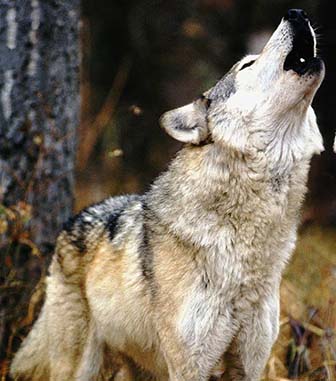
Wild wolves have had an impact on the human imagination. They have also been very much misunderstood. At one time with the exception of humans and lions, no other mammal had a larger distribution. Wild wolves could be found all over North America from Alaska to Arctic Canada and throughout Europe and Asia. They lived in every type of habitat except tropical forests and the most arid deserts. Wolves were domesticated several thousand years ago by Native American Indians and selective breeding produced dogs.
Travel is the ideal way of life for wild wolves. This is because their long legs, large feet, and deep but narrow chest suit it well for life on the move. They have keen senses and this combined with their large canine teeth, powerful jaws make it possible for them to pursue prey at 37 miles per hour.
Many wild wolves were tamed by Native American Indians and used to help carry their good though wild wolves are well equipped for a predatory way of life. The largest wolves are found in west central Canada, Alaska and across northern Asia; the smallest in the Middle East, Arabia and India.
Native American Indians that hunted for survival admired wild wolves and tried to imitate their behavior. More recently, wild wolves have been viewed as evil creatures, a danger to humans and a threat to livestock. The destruction of livestock was the primary justification given from eradicating the wolf from virtually all of the United States, Mexico and most of Europe. In the United States wolves were killed by every method imaginable in the 19th and early 20th centuries, and by 1950 they remained only in the northeast corner of Minnesota. In the late 20th century, a greater tolerance, legal protection, and other factors allowed their range to expand to portions of North America and Europe.
Wolves breed between February and April. A litter of usually five or six pups is born in the spring after a gestation period of about two months. The pups are usually born in a den consisting of a natural hole or burrow, often in a hillside. After a few weeks they are moved from the den to the “rendezvous site” above ground where they play and sleep while the adults hunt. Most pups are adult size by October or November. After two or more years in the pack, many leave to search for a mate, establish a new territory, or even start their own pack.
Wolves are probably more poplar now than any other time in recorded history. In 1995 wolves from Canada were reintroduced to Yellowstone National Park and Idaho, and captive-reared Mexican wolves were released to their former range in eastern Arizona beginning in 1998. At the beginning of the 21st century, an estimated 65,000-78,000 wolves inhabited North America with Canada having the largest population, followed by Alaska and Minnesota.
A Pack of Wolves Articles Home Page
The following lists catalog the specific articles, stories, legends and research materials of this website.
American Indian Topics | American Indian Products | American Indian Tribes
Native American Topics | Indigenous Peoples’ Literature
